
Professional 
microblepharoexfoliation.

Explore the clinical background,
scientific rationale and published evidence
supporting professional
microblepharoexfoliation.

01 – Background

The eyelid margin: a key component of ocular surface health

A highly specialised anatomical structure, essential for tear film stability, visual quality and long-term ocular comfort.

A delicate physiological balance

During each blink, the eyelid margin distributes the tear film evenly across the cornea, facilitates tear drainage and protects the ocular surface from environmental exposure.

Located along its posterior aspect, the meibomian glands continuously secrete meibum. This lipid-rich secretion forms the tear film’s outermost layer, reducing evaporation, stabilising the tear film and preventing excessive friction.

When homeostasis is lost

Biofilm, keratinised epithelial debris, cosmetic residues and environmental contaminants can obstruct gland orifices and alter the quality and quantity of meibum secretion.

The clinical impact

Blepharitis, meibomian gland dysfunction and evaporative dry eye commonly cause irritation, fluctuating vision, burning, foreign body sensation and persistent visual discomfort.

Why eyelid hygiene matters

Modern eyelid hygiene aims to reduce bacterial biofilm, remove accumulated debris, maintain meibomian gland patency and support tear film stability.

Environment

Epithelial cells, secretions, microorganisms and tears continuously interact.

Pathway

Obstruction and inflammation can destabilise the tear film.

Clinical focus

Restore eyelid margin physiology—not only isolated symptoms.

02 – Procedure

Microblepharoexfoliation

Mechanical debridement for modern eyelid margin management.
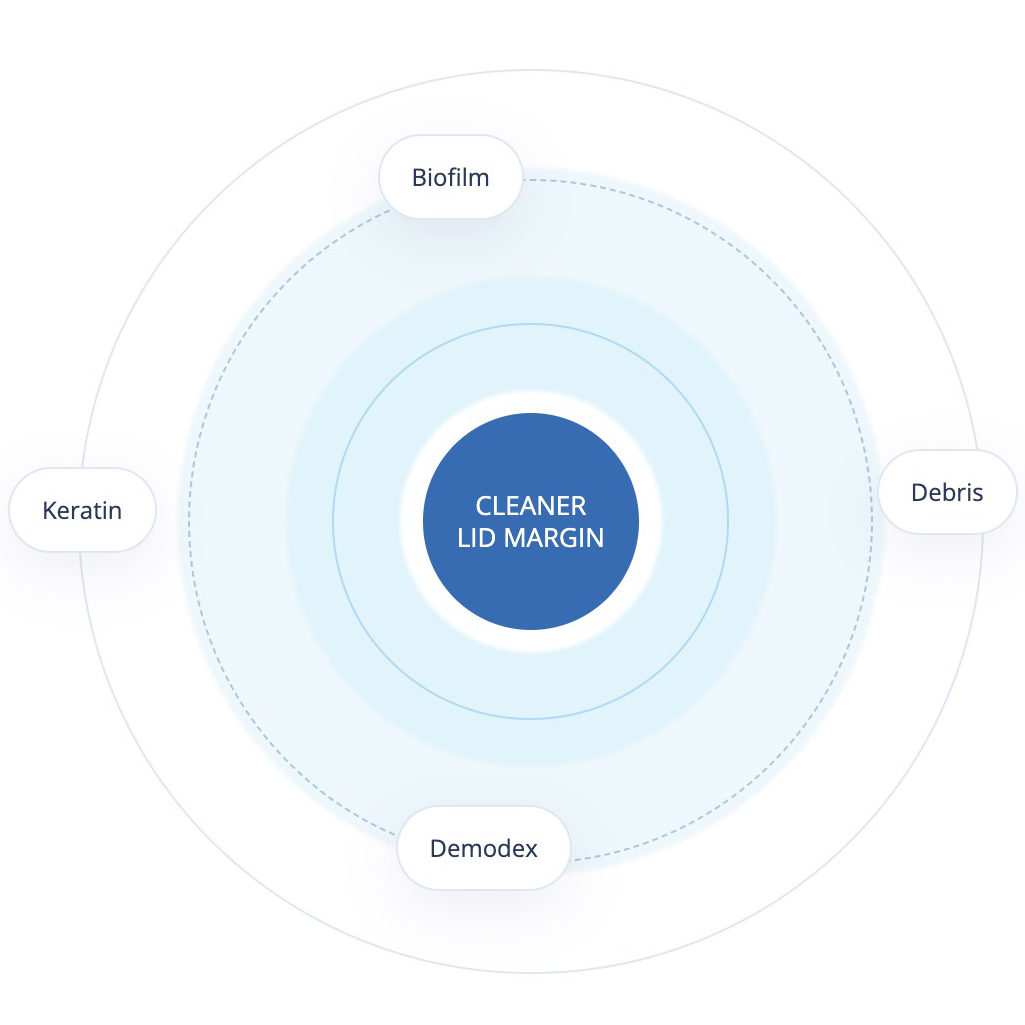
EyeClean - cleaner lid margin

The scientific rationale

Microblepharoexfoliation is an in-office mechanical eyelid hygiene procedure designed to remove accumulated debris, bacterial biofilm, keratinised epithelial cells and cylindrical dandruff from the eyelid margin.

Performed using a dedicated rotating microsponge under professional supervision, it directly addresses the mechanical component of eyelid margin disease while preserving the integrity of surrounding tissues.

A comprehensive approach

Professional treatment provides intensive, controlled cleansing that cannot be achieved through routine home care alone. Daily eyelid hygiene then helps maintain the benefits within an integrated, personalised strategy.

03 – Evidence

Published evidence supporting microblepharoexfoliation

Clinical research has progressively investigated mechanical eyelid margin debridement across several ocular surface conditions.

01 / Clinical area

Blepharitis & Demodex

Randomised and prospective studies report greater symptom improvement and larger reductions in Demodex counts when microblepharoexfoliation is added to conventional eyelid hygiene.

Mohammad-Rabei et al., 2023 · Wang et al., 2024

02 / Clinical area

Meibomian gland dysfunction

Lid debris debridement combined with meibomian gland expression has been associated with improvements in tear film stability, gland function, symptoms and ocular surface MMP-9 levels.

Moon et al., 2021

03 / Clinical area

Evaporative dry eye

Studies suggest that mechanical eyelid margin cleansing may enhance multimodal protocols, with improvements in dry eye symptoms, tear film stability and meibomian gland secretion.

Xie et al., 2019 · Ballesteros-Sánchez et al., 2024

04 / Emerging application

Chalazion & perioperative care

Emerging evidence supports adjunctive use in chalazion, while international reviews increasingly recognise eyelid margin optimisation before ophthalmic surgery.

Zhu et al. · Schechter & Mah, 2022

Overall clinical perspective

Microblepharoexfoliation is not intended to replace pharmacological or other device-based therapies. The published evidence supports its integration as an adjunctive procedure within a multimodal approach to restoring eyelid margin health, improving meibomian gland function and optimising the ocular surface.

04 – Sources

References

Selected peer-reviewed literature and international consensus documents.

  • 1

    Nichols KK, Foulks GN, Bron AJ, et al. The international workshop on meibomian gland dysfunction: executive summary. Invest Ophthalmol Vis Sci. 2011;52(4):1922–1929. PMID: 21450913.

  • 2

    Geerling G, Tauber J, Baudouin C, et al. Management and treatment of meibomian gland dysfunction. Invest Ophthalmol Vis Sci. 2011;52(4):2050–2064. PMID: 21450919.

  • 3

    Jones L, Downie LE, Korb D, et al. TFOS DEWS II Management and Therapy Report. Ocul Surf. 2017;15(3):575–628. PMID: 28736343.

  • 4

    Zhang L, Wang J, Gao Y. Eyelid cleaning: methods, tools, and clinical applications. Indian J Ophthalmol. 2023;71(12):3607–3614. PMID: 37991291.

  • 5

    Sheppard JD, Nichols KK. Dry Eye Disease Associated with Meibomian Gland Dysfunction. Ophthalmol Ther. 2023;12(3):1397–1418. PMID: 36856980.

  • 6

    Xie WJ, Jiang LJ, Zhang X, et al. Eyelid margin cleaning for MGD-associated dry eye. J Zhejiang Univ Sci B. 2019;20(8):679–686. PMID: 31273965.

  • 1

    Moon SY, Han SA, Kwon HJ, et al. Effects of lid debris debridement combined with meibomian gland expression.
    BMC Ophthalmol. 2021;21(1):175.PMID: 33845799.

  • 2

    Mohammad-Rabei H, Arabi A, Shahraki T, et al. Role of Blepharoexfoliation in Demodex Blepharitis. Cornea. 2023;42(1):44–51. PMID: 35439775.

  • 3

    Wang HY, Shen D, Qi MY, et al. Terpinen-4-ol combined with eyelid deep cleaning. Transl Vis Sci Technol. 2024;13(11):22. PMID: 39560630.

  • 4

    Ballesteros-Sánchez A, et al. Diamond Bur Microblepharoexfoliation combined with IPL and MGX. Ophthalmol Ther. 2024;13(5):1223–1237. PMID: 38467993.

  • 5

    Schechter BA, Mah FS. Optimization of the Ocular Surface before ophthalmic surgery. Ophthalmol Ther. 2022;11(3):1001–1015. PMID: 35486371.

  • 6

    Fromstein SR, Harthan JS, Patel J, Opitz DL. Demodex blepharitis: clinical perspectives. Clin Optom (Auckl). 2018;10:57–63. PMID: 30214343.